Total Page Views

Showing posts with label teacher leaders. Show all posts

Tuesday, March 10, 2015

Teacher Leaders - The Wind Beneath My Wings #SAVMP 2:5


So today I am going to talk about MY classroom! Yes, the school and its teachers are MY classroom, and just like a classroom teacher, I get jazzed when my students (my awesome team of teachers) take risks and grow and demonstrate mastery of their learning. 

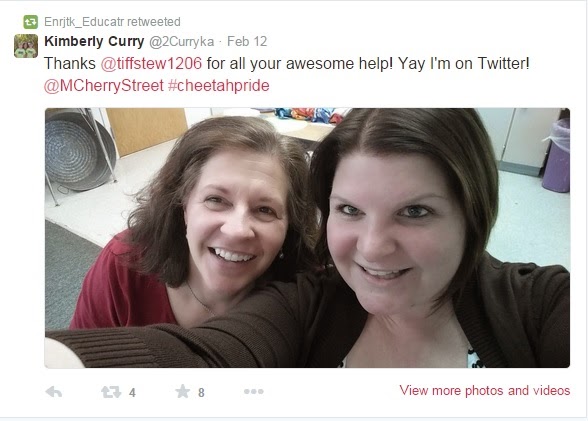
I have one teacher who took the teacher leadership challenge, and she is helping others grow as well. Since it is appraisal season, I was having one of those sit-down conversations with a strong teacher at our school. I was discussing the topic of teacher leadership with her. I shared that I wanted her to take on more leadership roles. Because she is a quality teacher, she was not afraid to raise questions with me. She shared that she felt she had missed the opportunity to lead in formal ways because grade chairs, school improvement team positions, and other formal leadership roles were already distributed. That is when we got down to some "real talk." I shared with her that my vision for the school was of a collaborative work force, and that I wanted to see leadership formally and informally. SHE WANTED TO KNOW MORE. I explained that teacher leadership should be exhibited by all teachers who have something to offer others. I wanted her to take on leadership roles that were beyond the status quo. I wanted her to be a "go-to" girl for new teachers, for her colleagues, and someone who positively impacts our campus for the greater good of our students. I began to see a gleam in her eyes. This was a paradigm shift for her, but it was one she quickly adopted. Sitting in the chair in front of me and my assistant principal,  she paused for a few seconds, and then she said, "Can you give me some examples?" I was amused by her enthusiasm and energy. I shared that there were a group of new teachers on campus who needed some help with their action research plans. I shared that we needed to be able to assist some of the new teachers with getting activated on Twitter since we were coming up on our second school #EdChat (#CherryElem). She said, "Okay, I will do that." Well, she wasn't kidding. She was SERIOUS and she meant BUSINESS! She walked out of my office, and went directly to the new teachers and asked them how she could help. She called me about an hour later, as it was getting dark on campus, and she said, "Hey, I am helping this new teacher and we have a question about the action research plan requirements." I got a huge smile on my face, and I was speechless! We talked through how to support that teacher. Then, the very next day, she got one of the new teachers on Twitter which is the picture you see above. 

Staff empowerment is such an important gift for our teachers. Teachers should not have to wait for a CEO type Principal to hand down decisions from above. Teachers should be empowered to come up with creative and innovative solutions on their own with collaborative input and monitoring by administration.


This teacher, Tiffany, was empowered, and she used her empowerment to empower others. Her excitement for the opportunity to lead others inspires me and my assistant principal. She has recently helped host our second school Twitter chat, and her leadership example stirs the excellence in others. Just since this school year started, we have seen all but 3 of our faculty members join Twitter. It has become a #BragTag fest where the teachers share the awesomeness of their classrooms. It has become a school-level PLN where we share and learn from each other's practices. AND, it has become an encouragement network for supporting each other's efforts to be #RockStarTeachers.  This same teacher, Tiffany, spontaneously got us all involved in a #TweetMob celebrating #EdJoy a couple of weeks ago. 


I have many others like her on my campus. She, and other teachers like her... are the wind beneath my wings.... 


Sunday, October 12, 2014

Action NOT Perfection Is the Goal


     Our school district and our school have embarked upon a new adventure with the advent of Professional Learning Communities. What is a PLC you ask? The Professional Learning Community is a method of working in schools where educators are continuously improving teaching and learning through collaborative practices done in consistent and regular work sessions. Our district is following the research of Richard Dufour, Rebecca DuFour, Robert Eaker and Thomas Many in the book, Learning by Doing: A Handbook for Professional Learning Communities at Work. 


     I feel like our school had a slight advantage in stepping into this initiative because we had been preparing for common assessments for two years. We spent the first year immersing our school in data analysis. The second year we spent reviewing data for student impact. This third year we are investigating and reviewing student AND TEACHER data to determine the differentiation needs and match them to the teacher practices! This is exciting work, and our campus has definitely got some pockets of greatness occurring. Even better, there is a collaborative dynamic all over campus, and it will only make us stronger and better able to serve our students. Everywhere on our campus we are moving forward which follows the greatest premise of the PLC mentality...

The goal is action, not perfection!

     Here is a video of our first grade team sharing their work through the PLC process. The items of brilliance to watch for are:

  1. Use of Norms
  2. Distribution of Roles
  3. Data Analysis of Student Achievement
  4. Alignment to the Standards and 8 Mathematical Practices
  5. Increased Rigor
  6. The use of other resources when the provided resources are insufficient
  7. Teacher-developed items formatted to the standardized summative assessment(s)
  8. The use of performance items
  9. The use of rubrics and progression scales
  10. Student self-assessment
     It is our hope to continue improving our practices at every opportunity, and this is definitely a step in the right direction. Click below to see the video on YouTube.


Thursday, March 27, 2014

What Are We Cultivating? #SAVMP 25


2013-2014 has been a year of growth for Cherry Street Elementary. We have added a TAG program, become an inclusive school, and replaced our core curriculum. The amazing by-product of the growth of these programs has been the growth of our faculty. I could write for pages and pages about how these programs have grown all of us, but tonight I will focus on our CheeTAG program.

When I took the job as Principal at Cherry Street I was made aware of several challenges. The school had seen its local community families turn to the private school down the street and to several charter schools in the area. We had many families left supporting the school, but if things didn't change we might soon lose them as well. Also, the school grade had been in decline for a few years, but the decline had been masked by the state's safety net.

My brilliant friend reviewed the master schedule with me in the early weeks of my new leadership role. She asked vehemently, "Where is the TAG program?" I explained that we didn't have one, and then we both pondered aloud the benefits derived from adding a program like this. First, it would keep families at our school--the families looking for the challenging programs provided at the charter and private school settings. Next, it would help build a layer of proficient students in our school achievement data...something that was missing. Further, it would allow my class-size restrictions due to state mandates to be flexed when building the master schedule because TAG classes are frequently multi-age. The premise of these programs is that students work at their mental age and NOT at their physical age. Lastly, having a TAG program would allow our staff and select groups of students to explore the most innovative and technology-driven aspects of today's educational offerings.

My first task was to locate the teachers who could tackle the obstacles inherent in implementing a new program while also learning how to be successful in managing such a program ALL AT THE SAME TIME. I knew just the right people. I asked two teachers on staff to consider taking the gifted endorsement coursework. It was a gift from heaven when both dynamic ladies agreed to take the coursework. They each seemed genuinely interested in the program we would implement in the upcoming school year.

Fast forward to the following summer. Both ladies finished their coursework ahead of schedule! Did I pick the right two or what? And, they began developing plans and curriculum for their classes. The teacher for the 4/5 combination TAG class even came up with a name for our program: CheeTAG since we are the Cheetahs at Cherry Street. I bought each of these ladies the book: Re-Forming Gifted Education, and away they went to the races! As we got closer to the start of school, we ended up having the students to create a combination 1/2 TAG class, a pure 3rd grade class, and a 4/5 combination class. Luckily, we had a 3rd grade teacher who was already endorsed for gifted education which allowed us to flesh out the program from grades 1-5.


The three fabulous teachers, our wonderful Student Services Coordinator, and I, all set out to create a diverse program that relied on student data to fashion personalized student learning goals for every content area of the program. From there, we embedded project-based learning, career-oriented learning, and technology-based learning. The results have been astounding, and we continue to see gains with almost 100% of the students in the program.

The teachers in these classes are positive, dynamic, and they are data-driven. Their malleability and willingness to work with a multi-age program that relies heavily on technology and increased engagement has provided our students with learning opportunities that are very unique. Two of the teachers are very excited about the possibilities for next year, and every time I get a chance to chat with them they tell me how much THEY have grown this year. For instance, one of the teachers sent me her engagement percentages for a lesson she taught last week, and she shared the pictures with me of the students who were VERY MUCH engrossed in the lesson. It was exciting to share the joy with her about trying to push student learning to the very highest level! Not only are our diverse TAG students growing, but our teachers are growing. So when this week's SAVMP assignment asked, "What are you cultivating?" I had to take this opportunity to share about our new TAG program and the progressive teachers who stepped up to the challenge to make certain our strongest learners continue to meet their own learning goals.


Sunday, September 22, 2013

Week 6 -- Roads to Innovation #SAVMP


Well, for this week's assignment, there were many ways to tackle it. I really didn't even have to BLOG. I could have just commented on someone else's entry, but instead I am trying to build my BLOGGING MUSCLES and blog more often. So I chose to answer the assignment via this question:

How do you go about creating innovative practices in your schools?

Certainly, as a new principal, at a turn-around school, I believe that I have not focused on innovation as much as I would like to; however, I do recognize innovation when I see it, and I know how to support it. 

I believe the easiest way to create innovative practices in our schools is ......simple......
YOU JUST SAY YES!

I have some brilliant and daring faculty who are true innovators. When they come to me and ask, "What do you think about this?" or when they inquire, "Would it be okay if I tried this?" my answer is always YES! YES! YES!

As the experts in the classroom, the teachers need my support when they are feeling courageous and want to branch out, especially in areas connected to technology integration.

I can recall multiple times over the course of the year where a teacher wanted to try something new. I fully supported them, and their idea blossomed, was a success, and it resulted in increased student engagement in learning. Risk-taking leads to innovation which leads to growth and success!

Step 2 for creating innovative practice at our school has been my Promotion and Praise of those who have taken the risks leading to innovation. I have 3 venues where I promote the practices of those who are taking the road to innovation. I promote and praise in my Monday Memo called the Cheetah Chat, in my Friday Focus called the Cheetah PUPdate, and during faculty meetings and/or after-school professional development sessions. The way to continue risk-taking behavior is to make certain it is rewarded. 

Innovation is critical in our ever-changing world. The technology is advancing so quickly that I can hardly keep up, and I am pretty close to the cutting edge of many types of tech. The problem will reach the tipping point  in education when the majority of children entering our schools know more about the technology than the teachers teaching them. In actuality, this might already be true in most high schools and many middle schools. Teachers MUST be innovators and need to embrace the culture of innovation to maintain relevance. I have set a new goal for myself this fall to try a brand new technology that I have not used yet. I am keeping my fingers crossed that I get there next month. May we all be innovators. Our students need it.  


Wednesday, April 17, 2013

Practice What You Preach


Practice What You Preach
                                                    

As a first year principal this year, I set out with a lofty list of goals to move the school vision forward. Now, as I am nearing the close of the school year, I am beginning to reflect on how close I have come to the targets I set for myself and for the school. We have come very far in a short amount of time. I am beaming with pride about many areas where I have grown personally and where I have seen my faculty grow as well. While it is true, that some goals were not met, I feel confident that growth was made and that we will pick up where we leave off this year and continue to pursue advancement with the ultimate goal of student achievement in mind!

One area where we have ALL grown exponentially is in the area of data analysis. Technology has advanced to the level that I can track and analyze data on just about anything. Through various initiatives this year, my faculty has begun to analyze data regularly to the point of asking for more data on their students and designing student assessments based on student need. Further, many of our teachers are now triangulating data as a best practice. It has been so exciting to watch this growth. I even have one team of teachers who have requested planning days this summer to begin creating common assessments in order to better assess student progress with the newly implemented Common Core State Standards. The great part about this request is that the team asked me for leadership support instead of me asking them to “get on board” with a specific initiative. This is what makes leadership enjoyable…seeing your teacher leaders driving change.

I think the most unexpected growth I have seen this year is in the “thirst” for data analysis occurring all over campus. I have been modeling data analysis at every opportunity. For example, I place bar graphs of diagnostic data and mid-year data in our Cheetah Chronicle (our internal Monday memo) and in grade chair and School Advisory Council Meetings. Next, I embed behavioral data analysis graphs in most every faculty meeting. I also demonstrate to the faculty any time that I make a decision based on data. We had a bus/dismissal situation in the afternoons that I was able to use specific behavioral data collected from bus discipline referrals to convene a meeting with the transportation staff. We plead an effective case because our data was so strong. And…I monitor data on everything: enrollment data, student session results from the computer lab programs, behavioral data, achievement data of every kind, attendance data, lesson planning data, and even energy conservation data (quantitative data). I conduct data chats with the teachers and have them reflect on their own student data. Lastly, I survey the students and the teachers constantly (qualitative data). We just completed a bullying survey and are currently collecting data with a cross-section of teachers in a lesson planning survey. Analyzing the results and making sound decisions based on their interpretation is critical to our success. 

The teachers see me “practice what I preach”. Perhaps this makes them feel empowered that they can also analyze data to make sound decisions. Whatever the case, there appears to be a layer of data analysis on our campus that was not there when I first came to campus. As a matter of fact, I knew we were making progress when one of my teacher leaders asked to train the faculty on the use of reports in the SuccessMaker program. She was conducting her training about analyzing the data, and she said, “You know we are all about data here.” I know I was grinning from ear to ear when she said that.


Where will this take us for next school year? I firmly believe that next year we will begin to closely examine the results of data and make interpretations based exclusively on what works BEST for our students. For instance, the questions should become very narrow: “Is the intervention I am using increasing student achievement?” OR “Is there a better intervention for increasing achievement?” Data is a part of the educator’s life. Data provides powerful tools to help us fine tune our craft, and it is absolutely critical that the leader is examining the data for the school’s progress continually. My advice….PRACTICE WHAT YOU PREACH.